Sunday, November 19, 2006

Thank You, Golden Corral
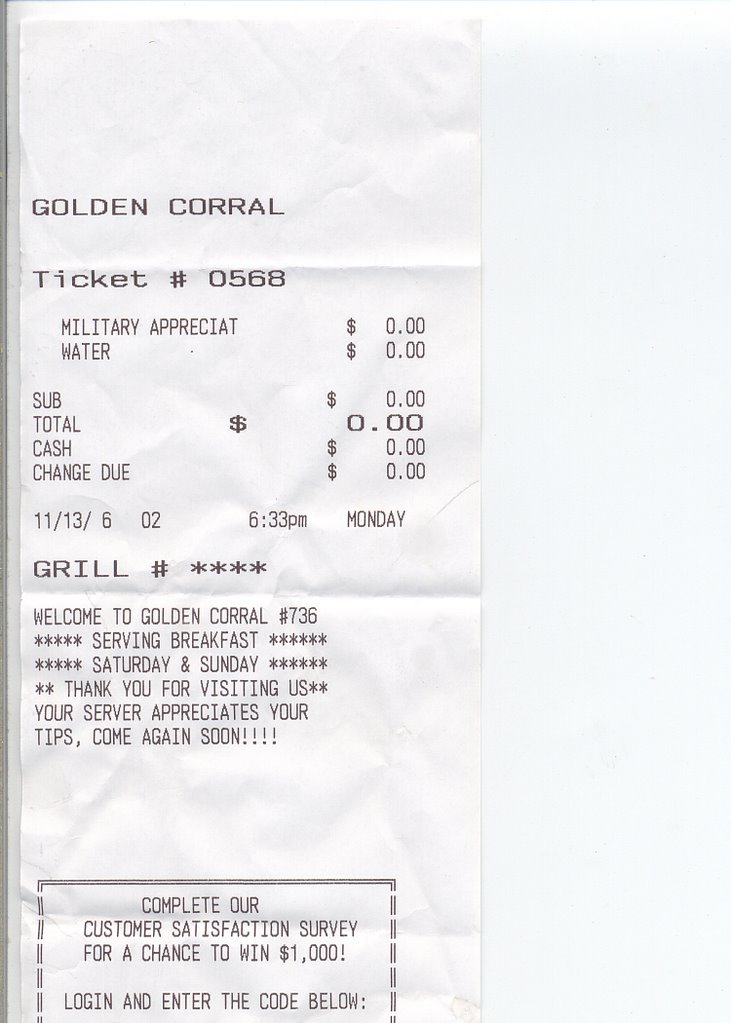


When someone wants to do something nice for you, let them. That's the mindset I embraced when I went to Golden Corral on 11/13/06 to join other veterans for dinner. For several years now the Golden Corral has honored veterans by feeding us a dinner meal around Veterans Day.

This free meal in 400 restaurants in 40 states is an incredible expression of appreciation extended to vets young and old. This was the second year I've joined them for this evening dinner of anything on their menu. The line of veterans and sometimes their spouses extended into the parking lot. The line moved quickly considering the large number of people eating. The wait- staff hustled in the dining rooms as the kitchen staff kept replenishing the food bars. It was service with a smile from all employees of the restaurant.

Due to another commitment, my wife couldn't join me this year so I went alone. I walked up to the end of the line behind a lady who recognized me as one who grew up in a neighborhood with her in the 1950's. I hadn't seen her in 40 plus years, I suppose. I talked with her and her husband, who served in Vietnam, as we slowly advanced to the inside. It was good to get reacquainted with this former neighbor and schoolmate who is now retired from a career at RJR Archer.

As I moved to the cash register inside, I collected my tray and water. The cashier handed me the receipt. (see above receipt which reads "military appreciat" Total $ 0.00) I progressed into the dining area where all tables were occupied by veterans and families eating all they could hold. I found an available seat where another veteran was eating alone so I joined him. We ate and talked about our military service experiences. He was in the Navy for four years in the late fifties and was from Connecticut. His name was Woodrow Wilson II. He said there would be no Woodrow Wilson IV because his son, the 3rd, had recently died without a son.

Anyway, we had an enjoyable talk and a wonderful meal compliments of Golden Corral. I hope you will patronize this restaurant throughout the year.

I thank the Golden Corral Corporate Office team as well as the restaurant managers and employees in Winston-Salem.

Return here on Tuesday, November 21 for an update.

Have a good day!

Labels:

Thursday, October 19, 2006

Homecoming


At Tan Son Nhut airport in Saigon I boarded a charter Trans World Airways Boeing 707 jetliner staffed by a civilian crew to begin the trip out of South Vietnam. The plane was fully loaded with GI's who had completed their tour of duty. All the flight attendants were stewardesses and the first American females I'd seen in a year. The date was some day past the middle of December 1966 and soon enough to get home by Christmas.

After takeoff, the jetliner circled Saigon in a steep ascent to gain altitude quickly before crossing the countryside where missiles or gunfire might reach the aircraft.

We flew to Tokyo where the plane landed to refuel. We did not deplane at that stopover. The flight continued from there to Anchorage, Alaska. I was amazed at the way the giant plane landed without skidding on a runway that was covered by a deep layer of ice. We deplaned there for a couple hours as the aircraft refueled again and probably changed to a fresh crew.

We departed Anchorage and headed across Canada. It was night as I looked out the airplane window and saw mountainous terrain completely covered by snow. I remember thinking that if this plane crashed in the desolate landscape below that our bodies would never be found. The plane flew for hours across snow covered mountains which was in contrast to the ocean we flew across first. The white snow was visible below even though it was night.

After flying 9,500 miles for 22 hours on a quiet flight of sleeping GI's (I didn't sleep much), we landed at McGuire Air Force base in New Jersey. After a day and night of processing through the center there, I purchased a plane ticket to fly on Piedmont Airlines from New Jersey to my hometown of Winston-Salem, North Carolina.

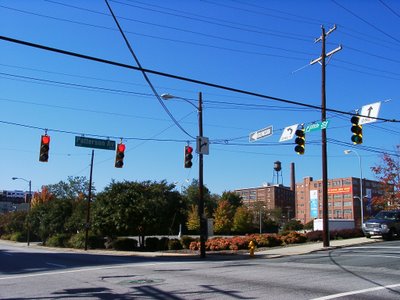
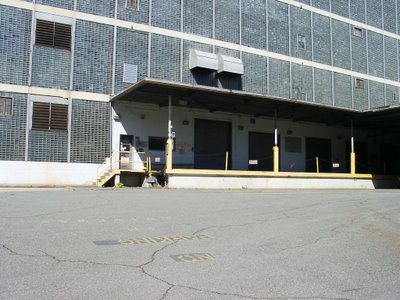
After a couple stops along the way from New Jersey, I landed at Smith-Reynolds Airport in Winston-Salem where I called a taxi to take me to my father's workplace at the road intersection of Patterson Avenue and 5th Street. The first picture is a current photo of this intersection and the next photo is a current view of my destination at that street corner which was the dispatch office at that time.

The window on the dock was the truck dispatch office for R. J. Reynolds Tobacco Company where my father worked. My father did not know exactly when I would arrive in town. I identified myself to the dispatcher who then radioed my father's truck.

I stood around the dock and parking area shown in the picture for several minutes until my father drove up. I remember that he got out of his truck, approached me, and gave me the biggest embrace and hug that I had received since I was a child. It lasted a long time.

My father drove us home where I received other family welcome home hugs.

It was only a few more days until Christmas 1966 which was a joyous time.

Return here on Saturday, October 21 for something different.

Have a good day!

Labels:

Tuesday, October 17, 2006

Only a Few Weeks Remaining


As my departure date grew closer, I became more nervous about the possibility of dying or being wounded seriously. All soldiers experienced these emotions as their one year tour of duty approached completion.

I began to hear reports of soldiers returning to the United States to a growing segment of unappreciative people. I heard of some being spat upon by protesters meeting them at airports.

Many years later an exhibit at The Sawtooth Center for Visual Art in Winston-Salem, North Carolina displayed a collection of still pictures depicting the Vietnam War veterans from the triad area of North Carolina. The exhibit included sixty pictures by veterans and their comments from interviews with exhibit organizers. The collection is called A Thousand Words and has traveled around the area since its first showing.
When I toured the exhibit, I read a comment on a poster that went something like this as one veteran remarked about his return trip from Vietnam. He said "I flew from San Francisco to Atlanta and then to Greensboro. Not one person on the planes or in the airports spoke a word to me." In other words no citizen expressed welcome home, thank you, any interest or concern whatsoever by anyone.

It astounds me how the general populace in our country ignores its warriors. I believe if it were not for VFW members celebrating each other and the United States government's observance ceremonies of Veterans Day holidays, there would be little acknowledgement of our country's defenders. Some churches do a good job recognizing people who put themselves in harm's way for perceived national interests that our government decides are necessary.

I sense similar unappreciative attitudes about first responders like firemen, policemen and other emergency personnel. My observation has been that these sentiments seem most present among people who consider themselves professional, executive, educated, or wealthy. I rarely see these people going out of their way to attend parades, services or ceremonies. It is very strange to me that the World War II generation produced such an abundant crop of uncaring and thankless offspring.
Not all people act this way, but I feel there are many thankless people ensconced in powerful and influential positions.

My final post about this period in history will be in two days when I describe my homecoming.

Return here on Thursday, October 19 for an update.

Have a good day!


Labels:

Sunday, October 15, 2006

Discover Veterans


The Vietnam war ended as 2,594,000 personnel served inside the borders of South Vietnam. In all the years after my one year in Vietnam I never met another person who was there at the same time in the same places where I served in the 1st Brigade of the 101st Airborne Division. That was true until recently.

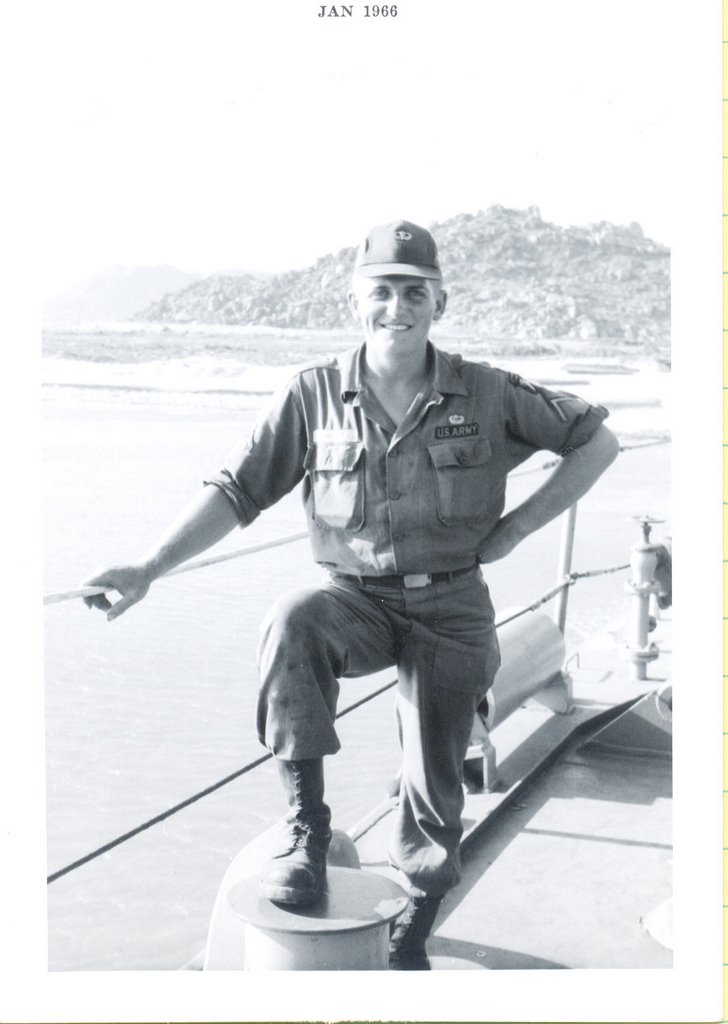
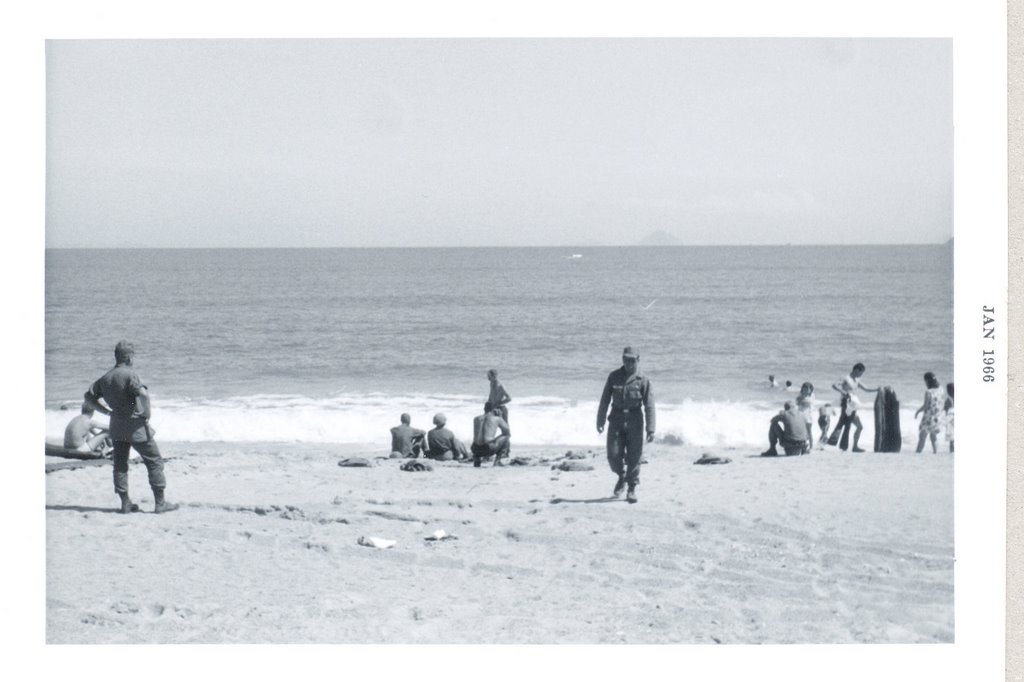
The LST (Tank Landing Ship) in the top and below pictures transported us from Phan Rang to Tuy Hoa. I estimate there were a thousand soldiers and much equipment on board as we sailed the coastline in the South China Sea. The sea waves were choppy so we spent three days and nights on this ship until the water calmed enough for the ship to beach for unloading.

Around 38 years after I took these pictures, I met a man who was on board that ship with me and spent a year in Vietnam with the same airborne unit in the same places as I did. I'll make a long story short by writing that I met him at his wedding when he married a friend and colleague of my wife. This was a second marriage for them.

As he and I confirmed our Vietnam history, I learned he was a West Point Military Academy graduate and company commander. He continued his military career and retired with the rank of Colonel. He and his new wife visited our home where we talked about people, places, events, missions and looked at old pictures together. We agreed that we probably were as close to each other as a hundred yards several times on the ground in Vietnam and never knew each other. We are friends today and see each other periodically throughout the year.

After I met the retired Colonel, I visited a friend in the hospital at Wake Forest University Baptist Medical Center in Winston-Salem, North Carolina. While sitting in the waiting room, I saw a man there wearing a cap with the 101st insignia. After watching him and his family awhile, I approached him, introduced myself and asked about his cap. The conversation led to the discovery that he, too, was in Vietnam at the same time, in the same airborne unit and in the same places as I did. He made his career as a policeman in New York and retired to North Carolina.

The coast along Vietnam was beautiful as some parts were sandy beach as shown in the bottom picture while other parts were steep cliffs rising out of the waters edge.

Return here Tuesday, October 17 for the beginning of the end of writing about Vietnam.

Have a good day!


Labels:

Friday, October 13, 2006

Behaviors


Neither in Vietnam nor in college was I ever approached by a drug dealer, a homosexual, or a friend (or foe) to encourage me toward that kind of behavior. I've often wondered why I've never been sought by these kinds of people. The conclusion I reached was that my demeanor, the way I present myself in speech and thoughts, and the people and places I associate don't give the impression that I'd be receptive to such an invitation. I was (am) comfortable with my persona.

Most everyone has heard reports of drug use by soldiers in Vietnam. I was there for one year and did not observe any such behavior by soldiers around me. Drugs were absent from my thoughts and an unknown substance. If drug consumption was happening, then it was in support groups in rear areas and unbeknownst to me.

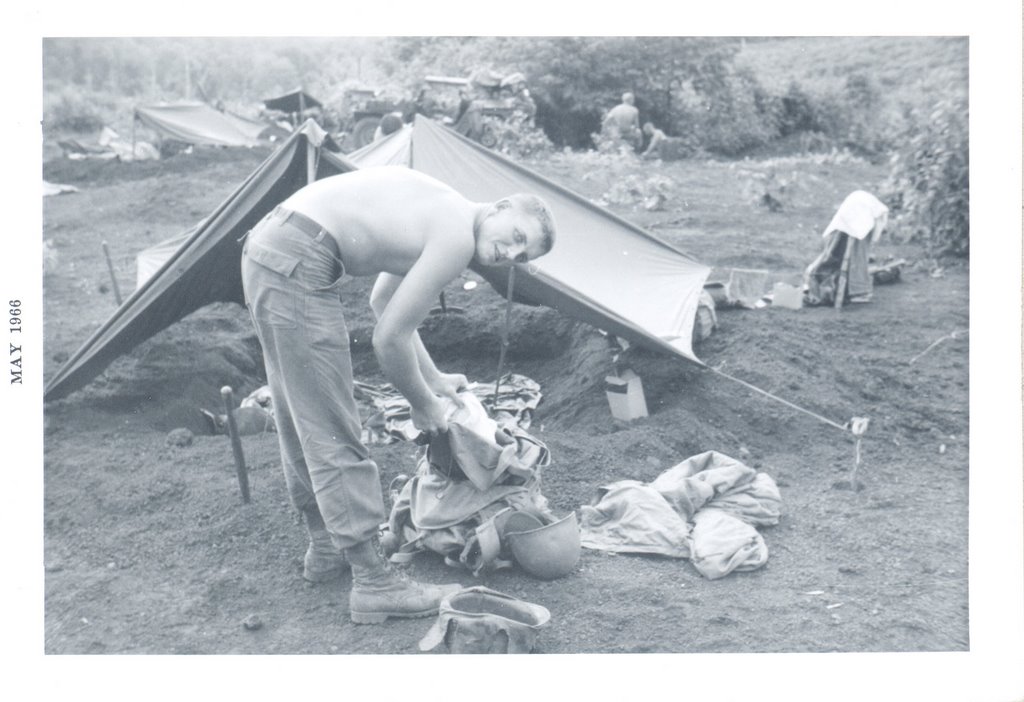
Look at the top picture and see the sandbag wall with the pup tents attached to the upper row. Underneath each tent were two cots separated by three or four feet and a sandbag wall between each tent. This is where we slept when we returned from missions in the field.
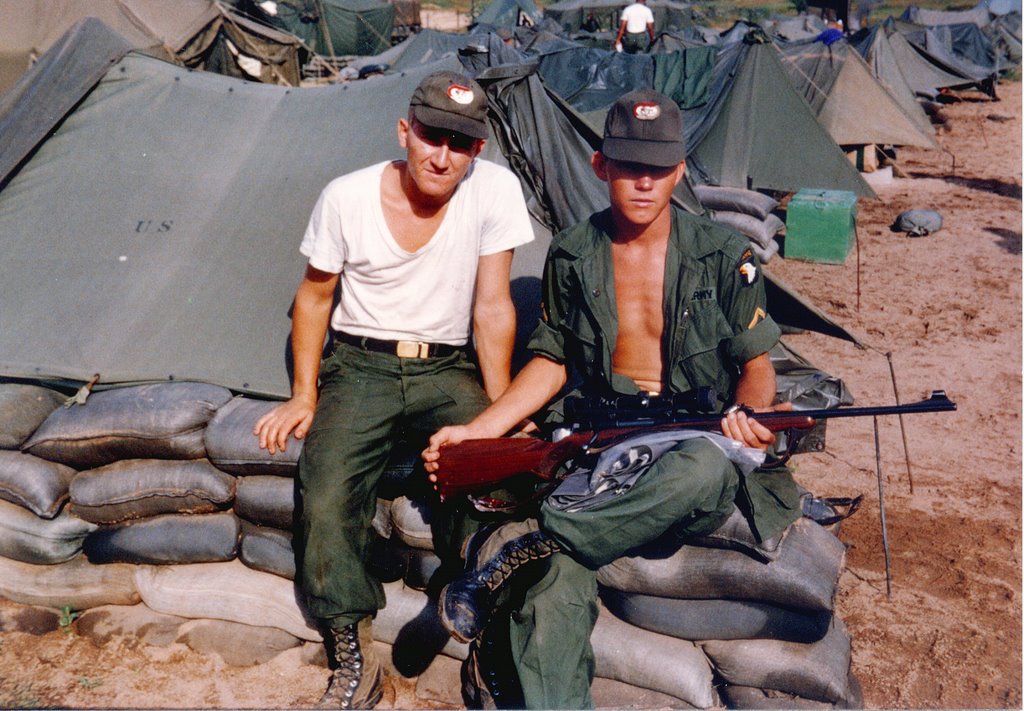
One night, as we were sleeping, some of us were wakened by a commotion of yelling inside one tent. This yelling was followed by running footsteps along the sandbag wall - one man running behind another as the one following the first was cursing and yelling as he apparently chased after the first.

When morning came and questions were asked among us all, we observed our staff sergeant with a swollen and bruised eye. We also learned that the lower ranking man in the cot beside the sergeant was awakened during the night as the sergeant performed genital petting on him. The man awakened by this act slugged the sergeant and chased him from the tent in a furious rage.

The next day the officers conducted an investigation and the sergeant was sent away never to be heard from again. We assumed he was transferred to another unit or sent back to the United States.

The staff sergeant was my squad's leader for months leading up to this incident. I was the radio operator for him which meant I carried his radio and was close to him day and night as I handed him the short-corded receiver to communicate and coordinate our movement and actions with other squads. He was a black man, a career soldier, and a good leader of our squad. Squad members were suspicious about his manner at times and sometimes wondered about him, but he never made intimations to me.

Terms like gay, homosexual, sexual orientation, gender preference, don't ask-don't tell were not in use in 1966. I never heard terms like these where I grew up in Pfafftown.

You can probably imagine how uneasy one might feel sleeping next to a person who might be sexually attracted to you. This could result in lack of rest for the needed peak performance the next day.

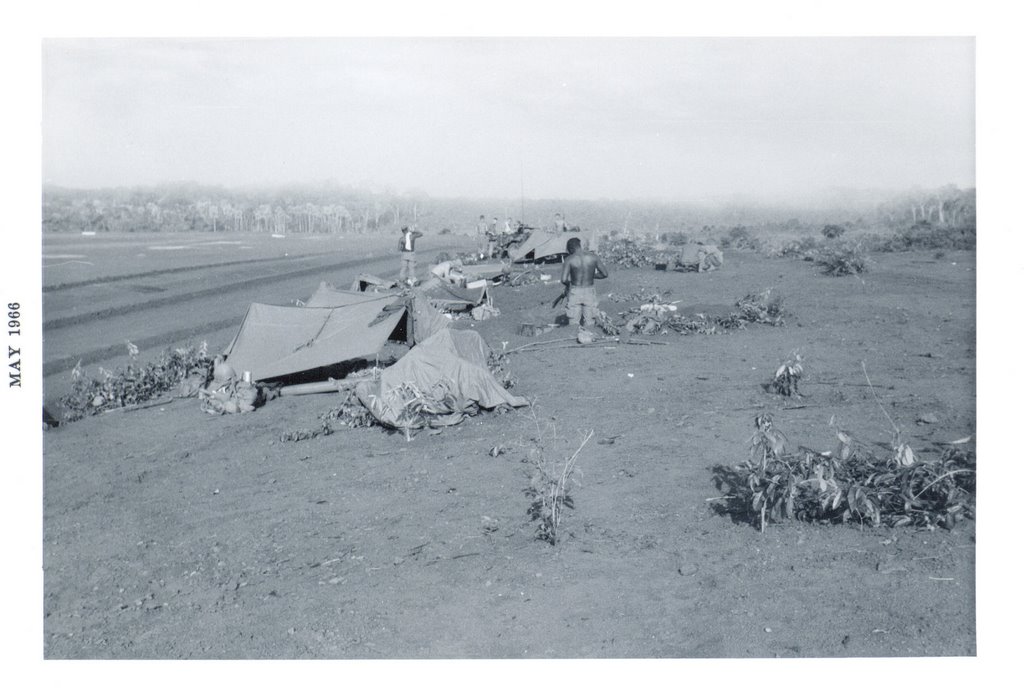
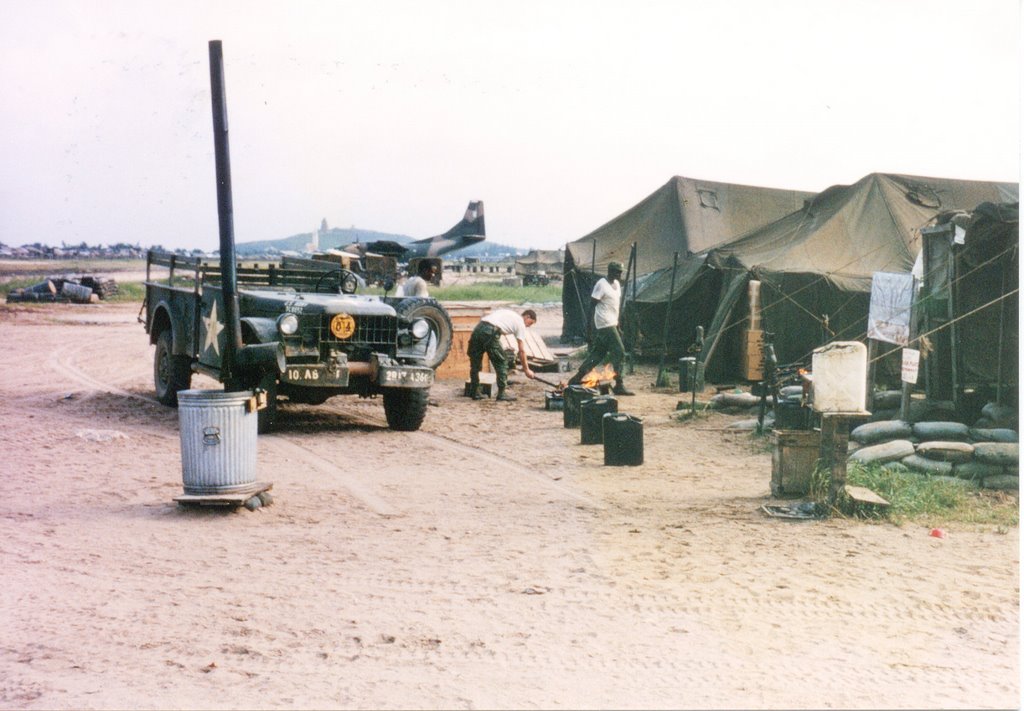
The mess tent in the below picture was erected near the airport runway beside our pup tents in Tuy Hoa. See the tail section of a fixed wing, camouflage painted airplane in the background.

Return here on Sunday, October 15 for an update.

Have a good day!

Labels:

Wednesday, October 11, 2006

Prayer in Vietnam


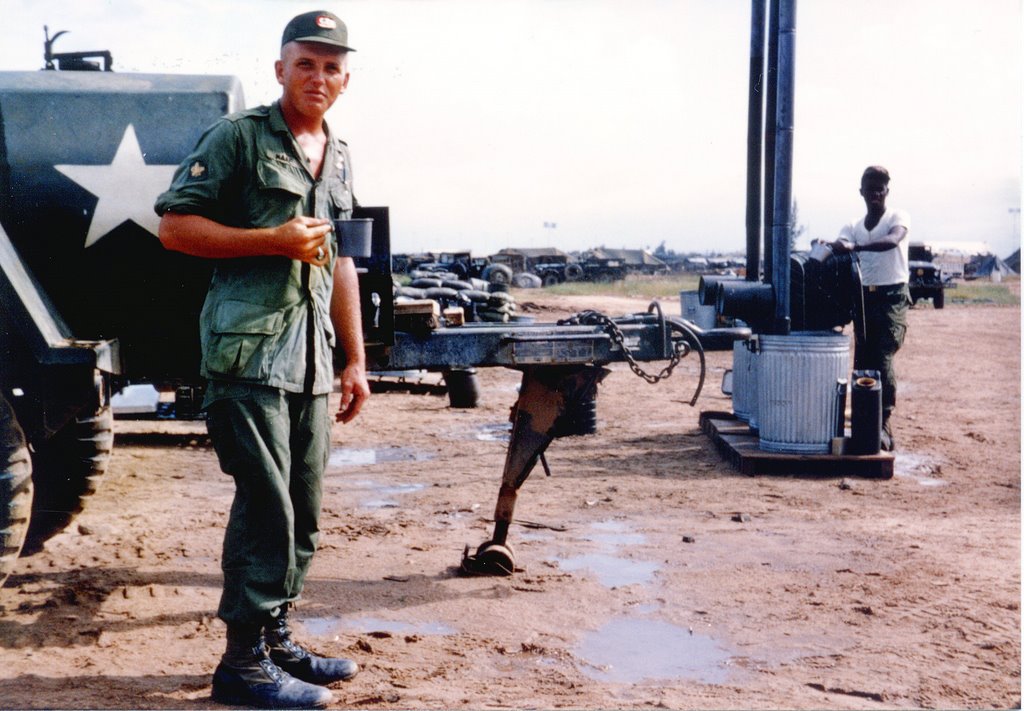
In the top picture I'm holding a canteen cup of water. This metal cup has a hinged handle that flips around the bottom and up the opposite side for stowing. It's then inserted in a heavy cloth pouch and attached to a pistol belt. A plastic quart water bottle, shaped as the inside of the cup, slides into the cup.

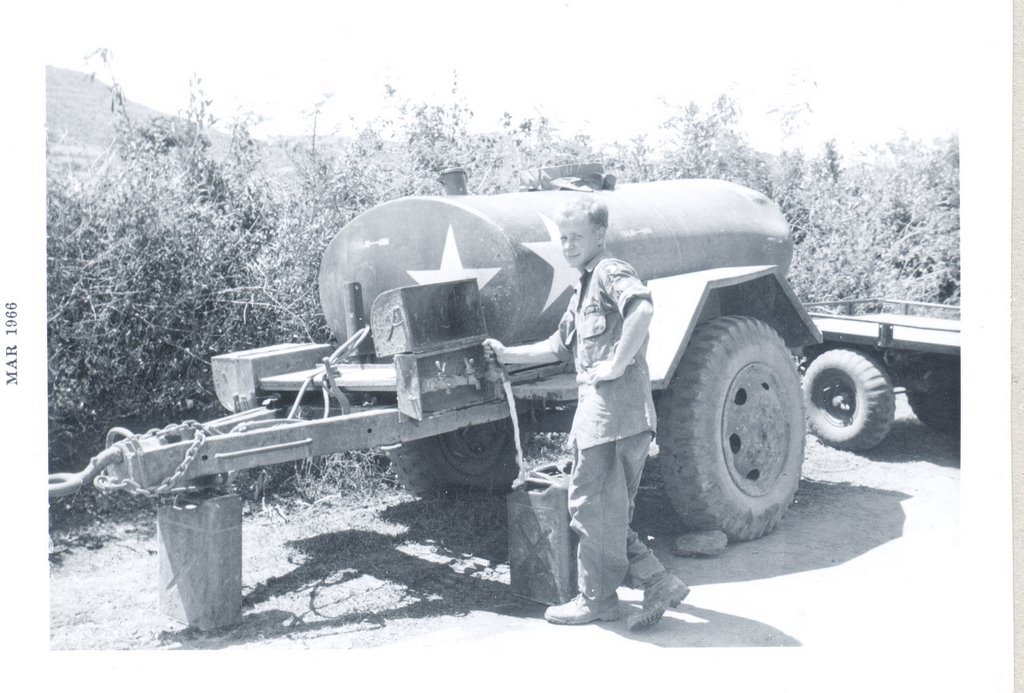
We received water from military water trailers as seen in these photos. This water had been purified by the Army for drinking and cooking.

While on foot patrols in the country, we often ran out of water and needed to drink from streams or rice paddies. This was very risky, but sometimes we were so thirsty we couldn't avoid the urge. During night movements, I've been so thirsty that I drank water containing lumps the texture of algae that I dipped from streams or pools with my cupped palm.

The three garbage cans to my left-front in the above photo were used for washing and rinsing our mess kits. The stacks protruding from the cans are heaters. One can was soapy and the other two contained hot rinse water. Mess kits consisted of 2 metal plates, a knife, fork and spoon. The plates fit together forming a sealed top to bottom for stow away. I used a mess kit when eating "hot chow". A mess tent was erected in rear areas for cooking hot foods. Sometimes hot chow was delivered to us in the field by helicopter. In those instances the food was hot and packed in insulated containers for spooning into our mess kits as we filed by the mess sergeant and his helpers.
I did a lot of praying while in Vietnam. I usually prayed at night while I was awake in the field on reconnaissance patrols. When on patrol, we prepared to ambush the enemy along a trail somewhere in suspected territories or near villages known to harbor Viet Cong. The sergeant in charge decided where each of us should be positioned to cover the trail without shooting each other. Two men were assigned to a position. The patrol consisted of about ten men total. Throughout the night, one of the two men at each position was awake at all times. We rotated two hours asleep, two hours awake to watch the trail. This pattern of sleep was devastating to me and it took years for me to regain continuous sleep during the nights.

During those long two-hour periods, I often looked up at the stars and prayed (sometimes it was pitch-black darkness and pouring rain). I prayed often for God to watch over me, to keep me safe, allow me to grow-up, to marry and have a family.

People who know me today, 40 years after 1966, know my prayers were answered based on my wife and resulting family. I give all the credit to the Lord for leading me to the lady I fell in love with at first sight. The romance began around three years after those prayers and lives on to this day.

The soldier in the below photo filled a five gallon container with drinking water to go onto a jeep.

Return here on Friday, October 13 for an update.

Have a good day!


Labels:

Monday, October 09, 2006

Bangkok for R & R


After I had completed six months in Vietnam, I was given a week of R & R (Rest and Relaxation). This was a reward offered to all service personnel serving in the country during that time. We had a choice to go to Singapore, Sydney, Hawaii, Hong Kong, or Bangkok. The military provided transportation to and from the chosen city and I decided on Bangkok.

I departed my combat unit in the field and flew by helicopter to our base camp in Phan Rang to get civilian clothes from my duffel bag stored there. This was the first time I'd been to our base camp since early January 1966 and it was then July. I don't remember if I flew from Phan Rang to Bangkok or if I connected with military flights in Saigon or Cam Ranh Bay.

Anyway, I arrived in Bangkok and spent five days there where I toured the city, partied as GI's do and ate in restaurants for the first time since leaving the United States.

After R & R, I rejoined my unit back in the countryside around Tuy Hoa and the central highlands for six more months.

Return here on Wednesday, October 11 for more.

Have a good day!


Labels:

Saturday, October 07, 2006

Outposts


We had few news reports while serving in the countryside and jungles of Vietnam. We knew the USO and Bob Hope were putting on shows in country, but that was in rear areas far away from where we were. Nobody in our units attended such entertainment that I'm aware.

We did begin to get word of mouth information that indicated some people in the United States were protesting our assistance to the government and people of South Vietnam. When I was there the year of 1966, the protests on campuses and in the streets back home had not escalated to the degree reached in the late sixties.

Throughout U. S. History up to the early 1960's, famous and important people put careers on hold to serve in the military. Some volunteered while others were drafted. Several famous major league baseball players were drafted and served during the 1950's. One famous draftee was Elvis Presley who served two years in the Army.

In the mid-1960's a famous athlete and world champion boxer received a draft notice. His name was Cassius Clay who had recently won the heavy weight title to become the world champion. Mr. Clay refused to enter military service amid much publicity at the time. A showdown between patriotic duty and willingness to serve in the military ensued. The final result was that Mr. Clay was stripped of his world champion title, but he did not enter the military. He later changed his name to Muhammad Ali.

Today, it is rare to hear of famous citizens volunteering to serve in the military. Pat Tillman, ex-NFL football player, was the most recent one I remember. He put his career on hold, joined the Army, became a Ranger and was killed in tragic confusion of ground battle in Afghanistan by friendly fire. This was most unfortunate because Mr. Tillman was setting a good example for other United States citizens of prominence to volunteer. The facts are, however, that only a small percentage of military personnel die or get hurt while serving our country.

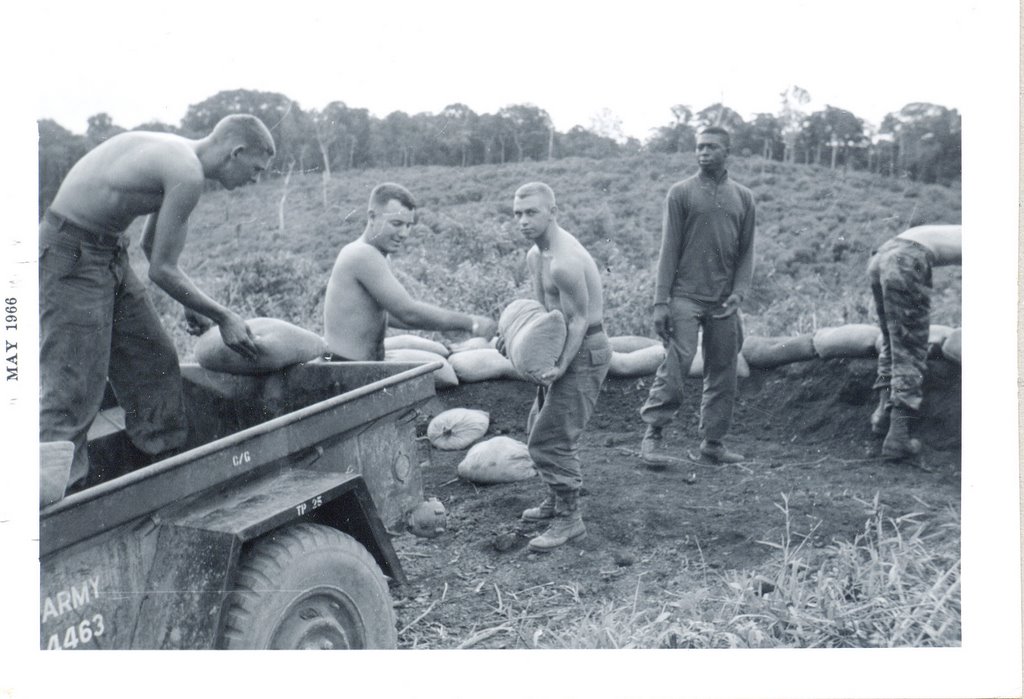
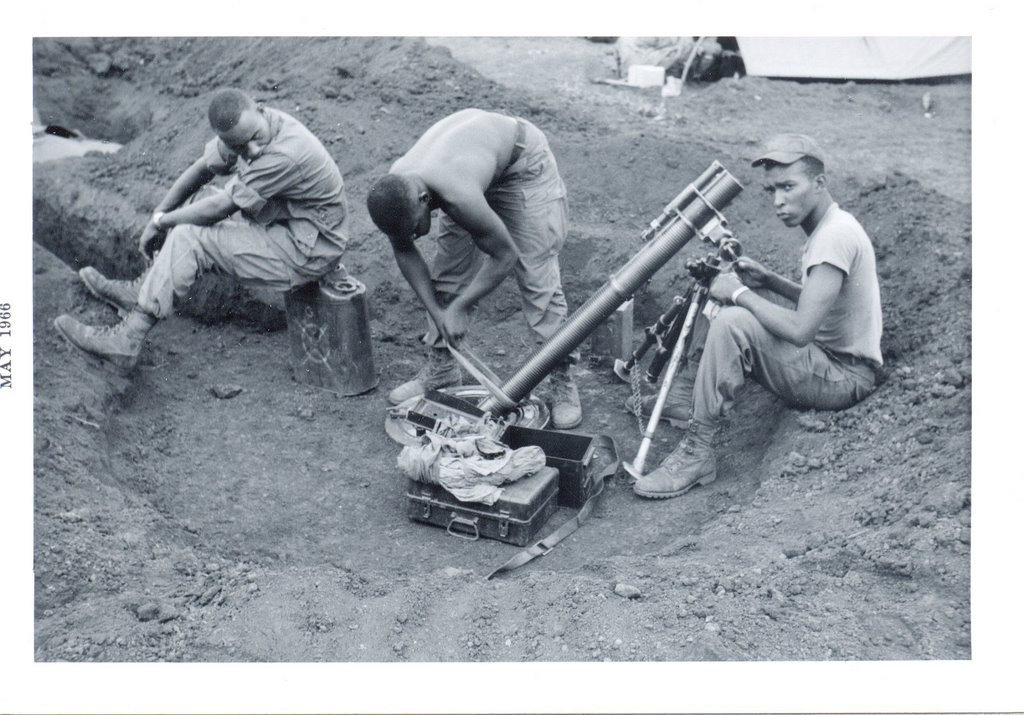
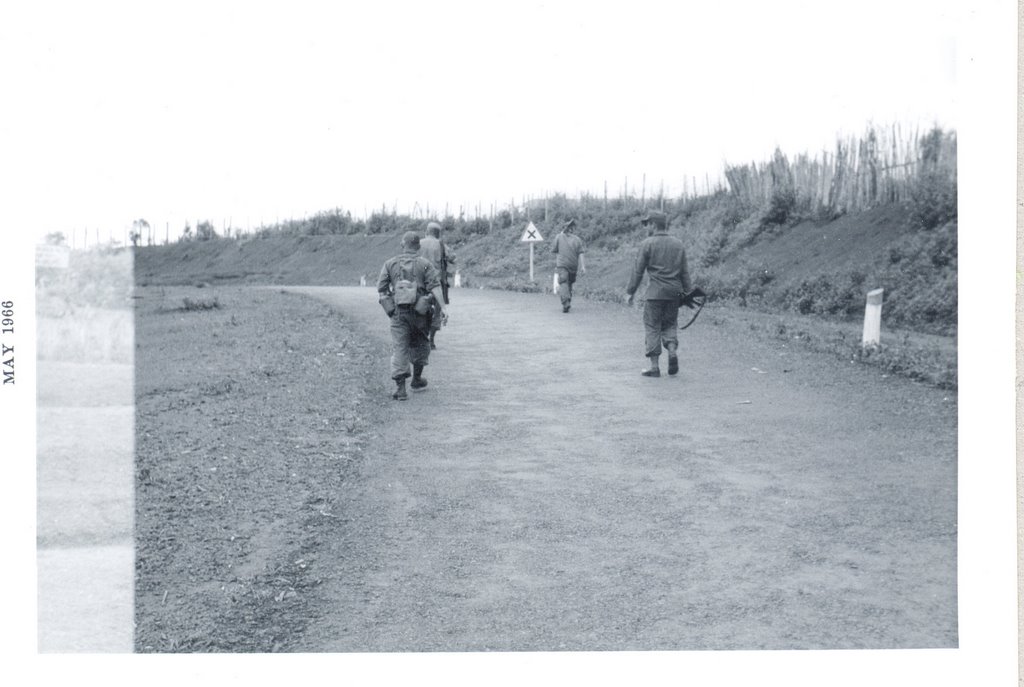
Two pictures here show fellow soldiers digging a protective encampment to set up mortar support for upcoming foot patrols to engage the enemy. I took these pictures and then returned to help fill sandbags. The bottom picture shows soldiers in my unit moving to patrol an area.

Return here on Monday, October 9 for more.

Have a good day!


Labels:

Thursday, October 05, 2006

MPC


My rank while in Vietnam was Private First Class for most of the year. My base pay was about $120.00 per month plus $55.00 parachutist jump pay and $65.00 hazardous duty pay. My total monthly pay was around $240.00.

We were paid in MPC (Military Payment Certificate) instead of Federal Reserve Notes. This type of payment was intended to prevent U. S. Currency from getting into the civilian population. The paper denominations were 5, 10, 25, and 50 cents, and 1, 5 and 10 dollars. The official South Vietnam Currency was the Piastre. I converted some of my MPC to Piastre to buy things in towns, but saved most of my pay. CocaCola was available but not chilled due to the scarcity of ice and refrigeration. Coke didn't taste the same there as it did at home.

The military sometimes brought shipments of beer and sodas to us.

Soldiers were encouraged to buy U. S. Savings bonds through payroll deduction. I enrolled in the purchase program while I was at Fort Campbell, Kentucky before going to Vietnam and received a $25.00 bond every three months after $6.25 per month was withheld from my pay. During that time, bonds cost 3/4 their face-value, now they cost 1/2 face-value.

While in Vietnam, I did not receive bonds as expected. When I returned stateside, I reported to the U. S. Treasury that I never received two bonds. Much time passed as I completed my three year commitment and was discharged from the Army in 1968.

One afternoon two FBI agents showed up at my home where I returned to live with my parents. My father and I were in the backyard when agents, dressed in suits and ties, came around the corner of the house. They showed me copies of the missing bonds that had been endorsed and cashed. I convinced them that I had not signed them. They knew it was not possible for me to have signed them and told me that a postal worker at Fort Campbell had been arrested for stealing incoming mail that should have been forwarded to soldiers in Vietnam. A few months later the U. S. Treasury replaced the bonds.

I continue to buy bonds and give them as gifts at Christmas to young relatives.

Return here on Saturday, October 7 for an update.

Have a good day!


Labels:

Tuesday, October 03, 2006

People and Action


Vietnam countryside was beautiful and the Vietnamese were hard working people. I was amazed at how they squatted instead of sitting on chairs or stools. I didn't see such resting devices in the small villages throughout the countryside where we were. The natives, young and old, squatted in a circle with their bottoms only inches off the ground and their knees at shoulder height. They sat this way for long periods.

The Vietnamese were thin and diminutive. Their youth were beautiful with jet black straight hair and nice complexions. Everyone wore conical hats, pajama-like pants and sandals if they wore shoes at all. Sandal bottoms were sometimes made from old vehicle tires. I knew that from studying their tracks.

I saw a lone man in the country side work for days gathering rocks the size of a basketball. He brought them to an area and then broke them to the size of a tennis ball ( not nice and round of course). He accomplished this manually using a small hammer as he squatted over the rock. He accumulated the broken rocks into a neat pile shaped like a pyramid. When his rock pile got big enough, a truck driver arrived to help him load the rocks onto the truck for delivery somewhere.

I observed men, women, and children planting rice in knee-deep water. Along the coast and other waterways, I watched fishermen casting nets and pulling their catches into small boats. I saw small children herd cattle. Life in their countryside was low-key compared to life in towns we passed occasionally.

When I grew through teenage years, I loved to hunt and trap wildlife. I hunted squirrels and rabbits, set traps for rabbits, and never passed an opportunity to shoot at doves, raccoon, fox and quail.

After I returned from Vietnam, my desire of hunting left me. In part, this happened because in Vietnam I experienced the feeling of being stalked and hunted. I experienced the sound of high velocity rounds passing near my head. I walked along trails in platoon patrol formation when suddenly a finite clap of thunder snapped near me. I didn't hear a bang from the gun that opened fire on me. I couldn't determine the direction the projectile traveled. All I heard were sharp, distinct snaps in space that I felt I could reach out and touch. It was frightening to realize that I was in the gun sights of a sniper or guerrilla fighter.

I also know what it's like to be hit by exploding hand granade shrapnel that was thrown by enemy North Vietnamese soldiers. I, along with others, was evacuated from a battlefield by a medivac helicoptor to a field hospital to remove one small fragment from my flesh wound. After three days of light duty, I rejoined my combat unit in the field.

In the top picture I was resting in a small Montagnard village in the central highlands. The bottom picture shows a view from around the corner where I was seated.

Return here on Thursday, October 5 for more.

Have a good day!

Labels:

Sunday, October 01, 2006

Mail Call! ... Mail Call!


Mail call was a sweet sound we heard from the company clerk when we returned to rear areas. Baths, rest, hot food, and mail from home kept us uplifted.

We gathered in a group around the clerk as he read the names on letters or packages. We reached through the gathered men when our name was called to get our hands on the delivery. A few men rarely or never received mail from home so the sound of "mail call" meant nothing and they were unmoved by the words.

As for me, I received letters from my father almost every time mail was delivered. Sometimes we were in the field for days and when we returned to the rear, I sometimes had four or five letters from home, all written by my dad. He was the one who wrote messages from my brother, sister, and mother. My father wrote a letter to me probably five times per week. When I received them in batches, I opened them in order of post mark date.

I remember them being in the same size envelope consisting of one to three pages of cursive handwritten words, correct spelling, complete sentences and easily legible.
Throughout that year, I probably received over 200 letters from him. I've recently thought how wonderful it would be if I had saved those letters in their envelopes. Imagine spreading out 200 plus envelopes on the floor of a room in a grid in date order.

I didn't have space to save his letters. If I knew back then what I realize now, I would have found a way to preserve them. I can feel how marvelous it would be to open his letters now, observe the paper he used, see how be wrote his sentences, study how he shaped his letters, and once again internalize his expressed thoughts and messages. I remember some of his messages to me were admonishment for not writing home more often.

When I wrote home, no stamps were required to mail a letter. I wrote the letters FREE in the top right corner of the envelope.

Have you ever received a similar flow of "snail mail" from a loved one? Or, have you produced a steady stream of mail to someone?

I don't remember receiving mail from extended family members. I sometimes wonder why words of encouragement and best wishes were never written by them to me.

Occasionally, my family sent me a package consisting of blocks of extra sharp cheddar cheese. I loved cheese then and I love it now. I've probably eaten, on average, one to two blocks per week throughout my life. When the cheese arrived in that hot climate, the oil poured from the package when I tore it open. My friends laughed and poked fun at the choice of food to ship that distance. Some helped me eat it, however.

Some men received the infamous "Dear John" letters. This is a letter from a girl friend who decided to break a promise to wait for a soldier's return. She began dating another man. I've seen the heartbreak, anger and depression this caused some men. This was not a problem for me because I had no girl friend or wife to send me a letter.

We used our helmet to hold water for shaving and bathing. The removable helmet liner separated from the exterior metal which was called a "steel pot". We flipped the camouflage cloth cover to the outside to create a wash basin.

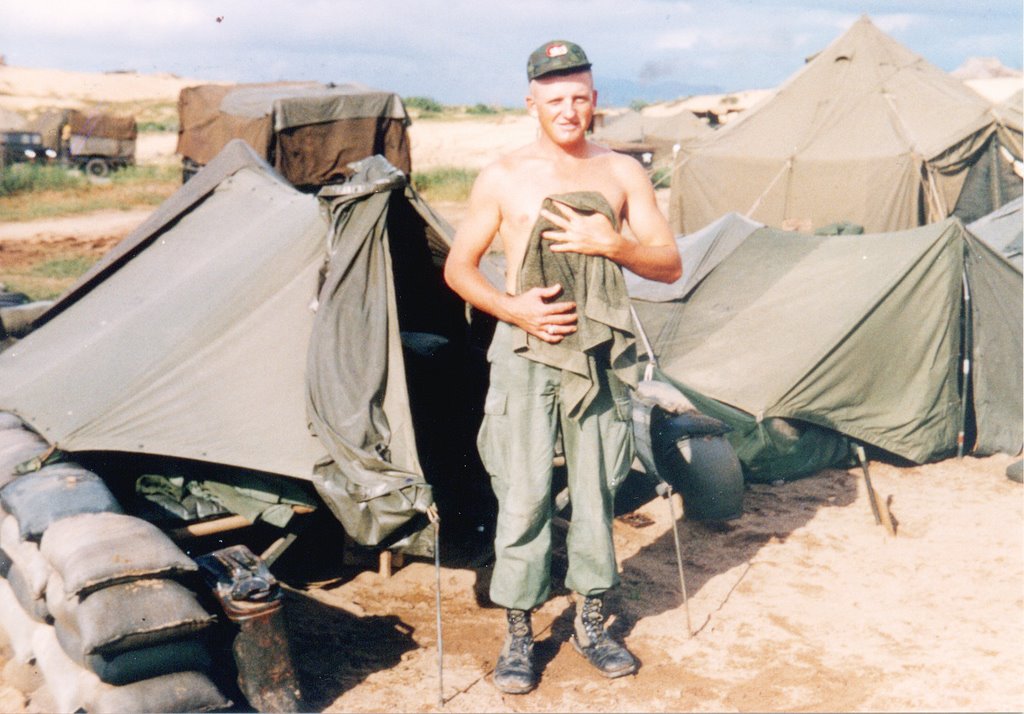
The first below picture is me drying off after a bath.

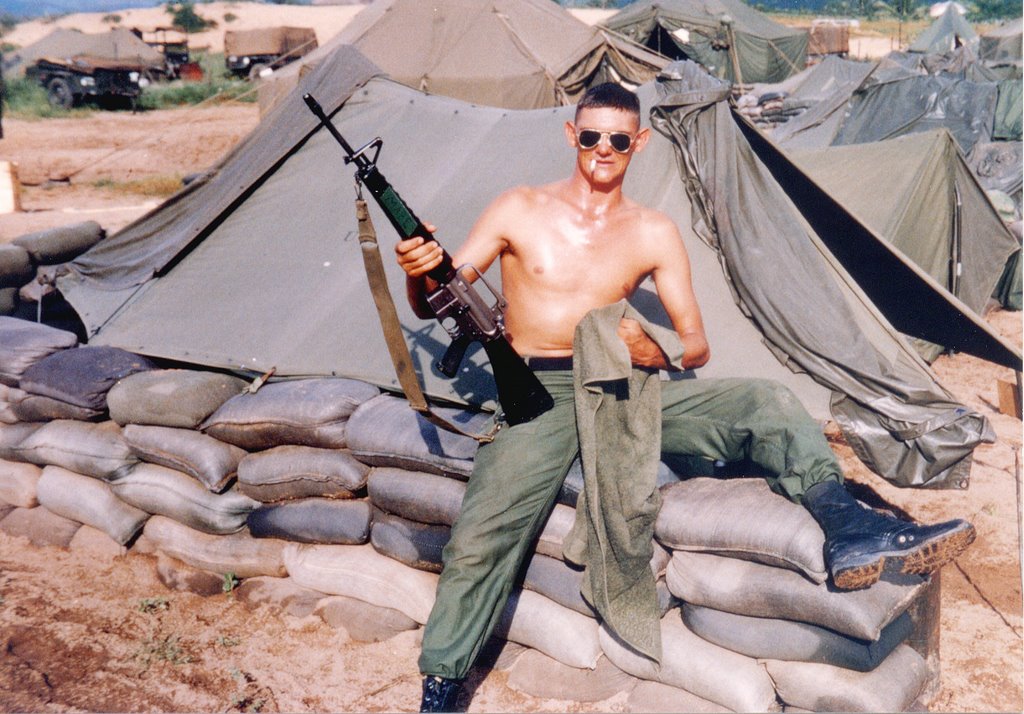
The last picture below is a fellow soldier wearing sunglasses. Generally, we were not allowed to wear sunglasses. The sunshine was bright there and I did lots of squinting to protect my eyes from the brightness.

Return here on Tuesday, October 3 for an update.

Have a good day!


Labels:

Friday, September 29, 2006

Air Strikes and Artillery


As infantrymen, we were on the ground confronting enemy. In Vietnam it was mostly in the countryside and jungles where they hid to prepare plans of attack to ambush or battle us head-on. When we engaged in battles that were especially fierce, we called in artillery and air support from the Navy and Air Force.

Our sergeants and lieutenants radioed coordinates for artillery bombardment when we were pinned down from enemy fire. I remember the sound of shells passing overhead as they landed and exploded in front of us. I didn't understand the coordinates system and physics that enabled artillery pieces a few miles behind us to fire projectiles to explode near without hitting us. Our officers were in radio contact with the rear support units to zero in on the enemy targets.

Many times we had air support. A fixed wing spotter plane circling above called F-4 Phantom or F105 Thunderchief fighter jets from Air Force units at Cam Ranh Bay. I've seen jets many times dive from high above, level out behind us, pass a few hundred feet overhead, release 500 pound bombs or napalm canisters, and pull up to disappear into the sky. Their after-burners blasted the fighter jets upward like a rocket. It was amazing to see. Their armament exploded in the jungle or countryside within a few hundred yards of us.

Napalm's shiny canisters exploded on impact and splashed into unbelievable fireballs. Bombs and napalm were released over our head and behind our positions as momentum carried them on a trajectory to targets toward our front. We could see their free fall through the air as we hunkered on the ground.

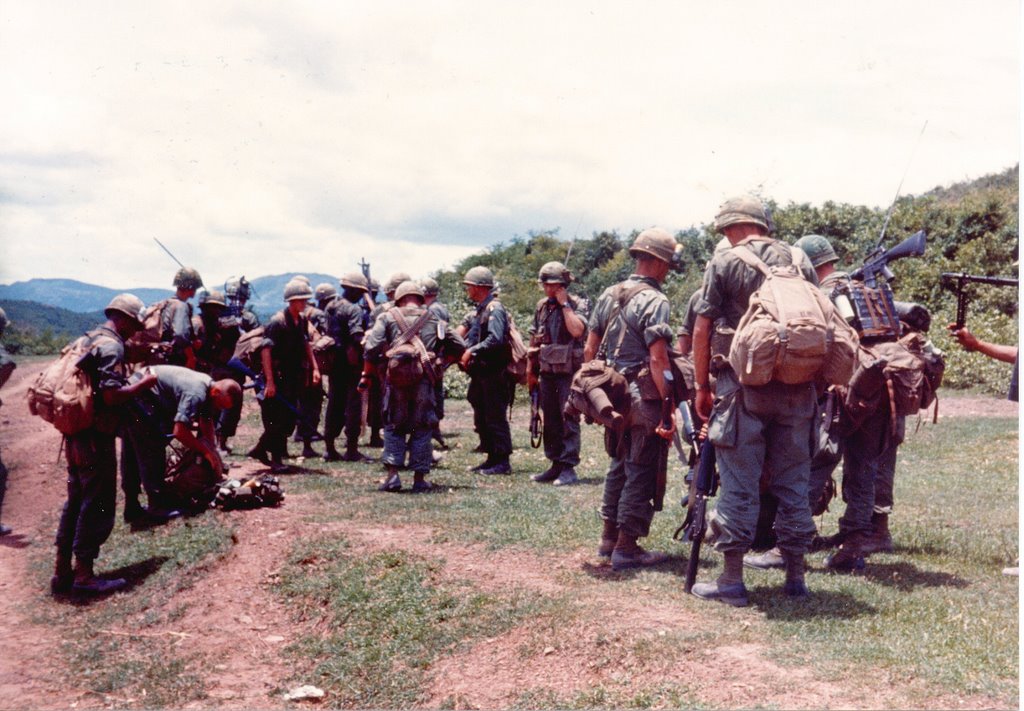
As you can tell from the top picture, we were loaded heavy with equipment, radio, ammunition, water, C-rations, claymore mines and hand grenades. There was no space to carry cameras and that was the last thing we needed in battles or the aftermath. Cameras were left in the rear areas. After I snapped the top picture, I handed my camera to the truck driver to take back to the rear.

We never had news reporters with us. I've since heard about famous reporters in Vietnam. I never saw any.

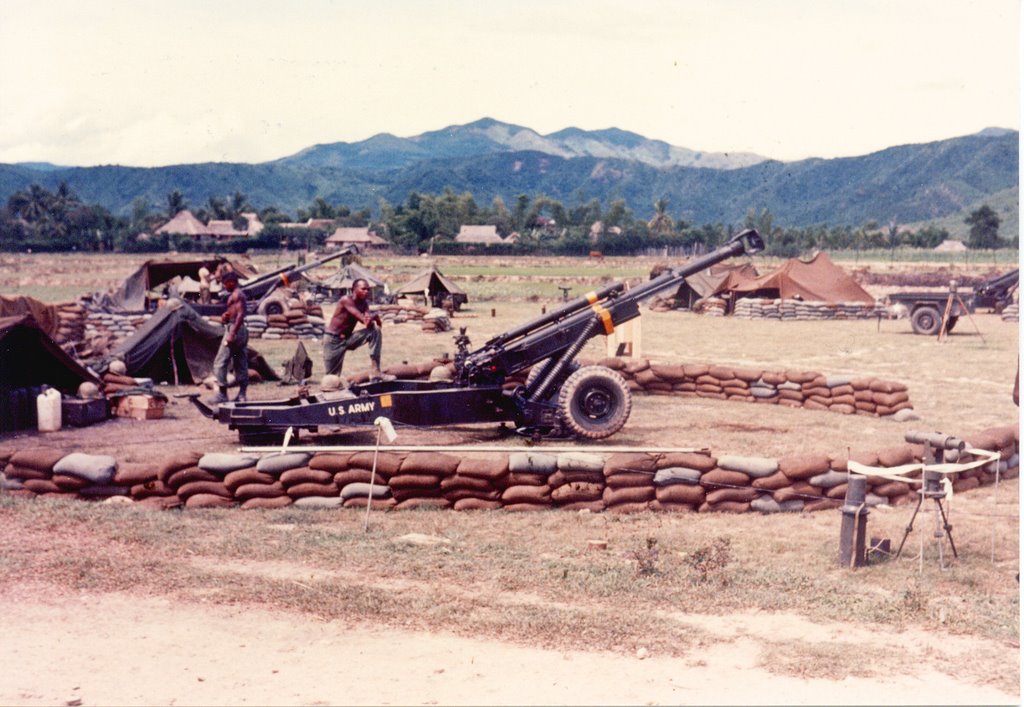
The artillery pieces in the below picture gave us support by firing explosive shells long distances.

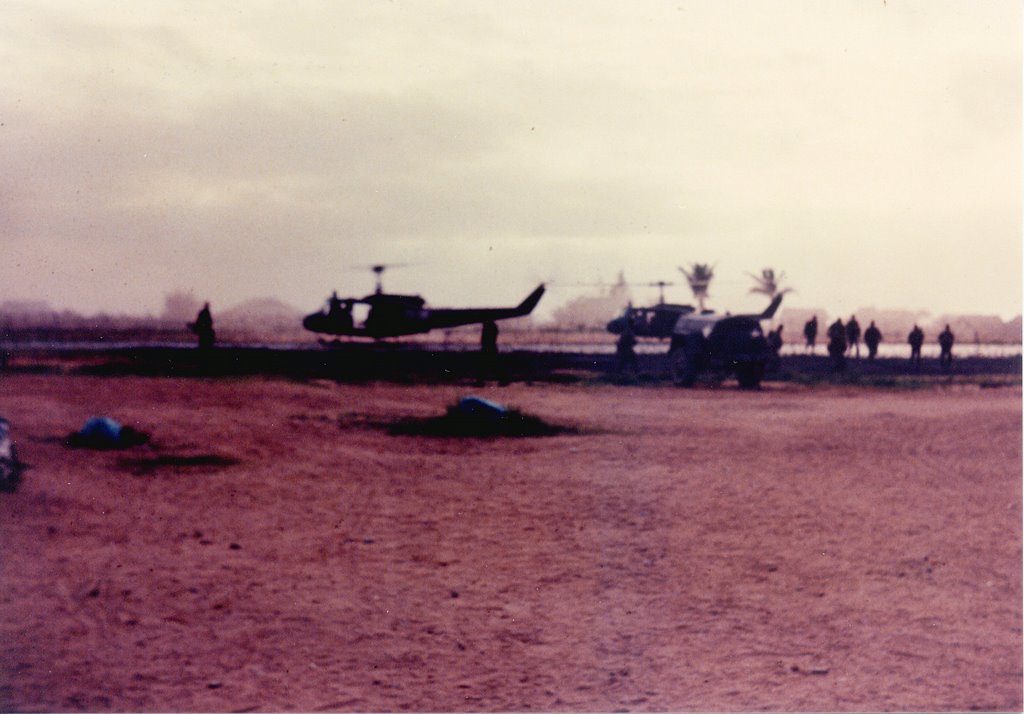
The bottom picture shows Huey helicopters delivering combat soldiers to a rear area.

Return here on Sunday, October 1 for an update.

Have a good day!


Labels:

Thursday, September 21, 2006

Central Highlands


The safest I've ever felt while flying was on board a C-130 Hercules flown by U. S. Air Force pilots.

We were in the central highlands of Vietnam which is mountainous jungle. We were guarding a dirt runway where engineers had excavated a mountain top. Bulldozers flattened the top to level a strip for landing fixed-wing aircraft.

We infantrymen dug foxholes in the ground beside the runway and stood guard around the perimeter a few days and nights. I saw many C-130's land and take-off on this short dirt runway. Some created the biggest dust cloud imaginable when these giant airplanes landed on the dry red dirt and reversed pitch on the props in order to brake their forward movement.

I saw some planes loaded so heavily as they raced down the runway for lift-off that only the front of the airplane was airborne when it crossed the runway's end at the mountain's edge. Some C-130's actually dropped below the imaginary horizontal plane of the runway before altitude was gained. I have flown and parachuted from this type airplane. The Lockheed C-130 Hercules is known as a workhorse for the Air Force.

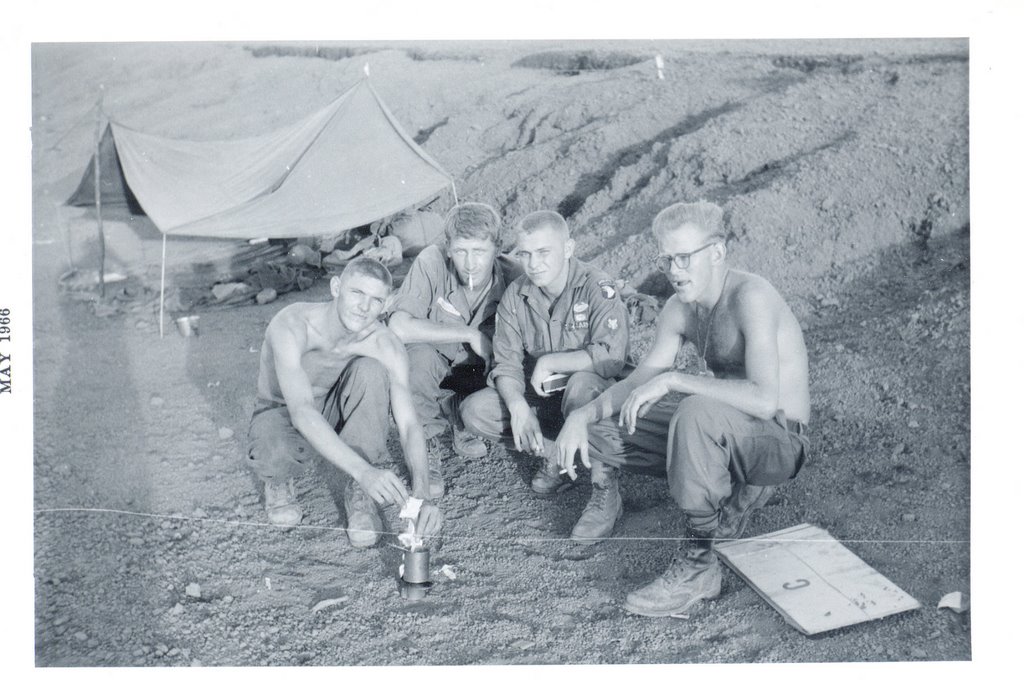
The four fellow soldiers in the above photo are heating a can of C-rations. We had heat tablets that were individually packed in a sealed foil-wrapper. They were about the size of a silver dollar, but thicker, and bluish in color. We opened cans of beef stew or ham, for example, set the can on small stones, and ignited a heat tablet under the can. The intense fire lasted about two minutes and warmed the contents. We heated coffee this way also. It took two or three tablets to get water really hot.

Once again, I don't recall the names of my colleagues here. I remember the one tending the fire was from Coats, North Carolina. Perhaps he will read this and email me.

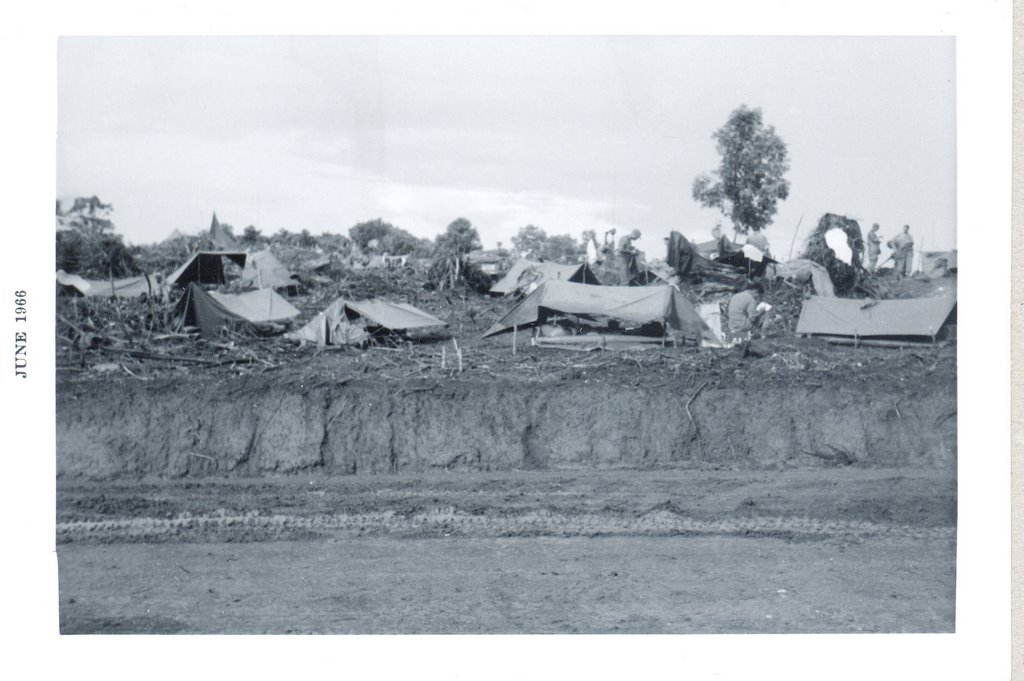
The first below picture shows our tents along the runway. The bottom picture shows a newly created clearing leading away from the landing strip.

Return here on Saturday, September 23 for more about Herschel.

Have a good day!


Labels:

Monday, September 11, 2006

Mosquitoes Galore


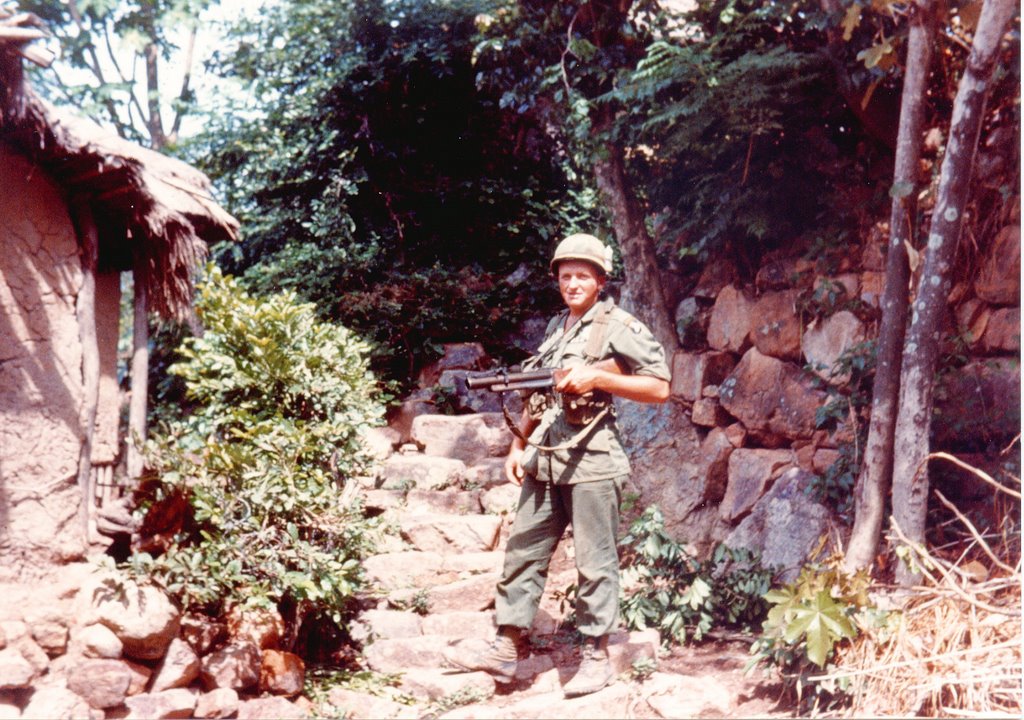
Notice the small, white, plastic bottle attached to the side of my helmet in the picture above. This was military-issued mosquito repellent which all of us carried and applied to exposed skin at night. Mosquitoes in the jungle and rice paddies ate us alive without this repellent. This liquid also worked well to cause leeches to release their bite when they attached to tender body parts during the night as we lay on the ground.

In addition to mosquito repellent, our platoon medic dispensed malaria pills for us to ingest daily. (It may have been weekly.)

I'm wielding an M-79 granade launcher in the same picture as we were searching a village for Viet Cong and their weapons. These searches usually occurred after we were fired upon from the village. Sometimes we were ordered to destroy villages after killed or captured enemy were dealt with and remaining civilians were removed. (This torching action was on a very small scale like that of General William Tecumeseh Sherman's troops when they marched through the South during our Civil War.)

Sometimes to clear a village meant entering tunnels, which was very scary, but some men faced that responsibility.

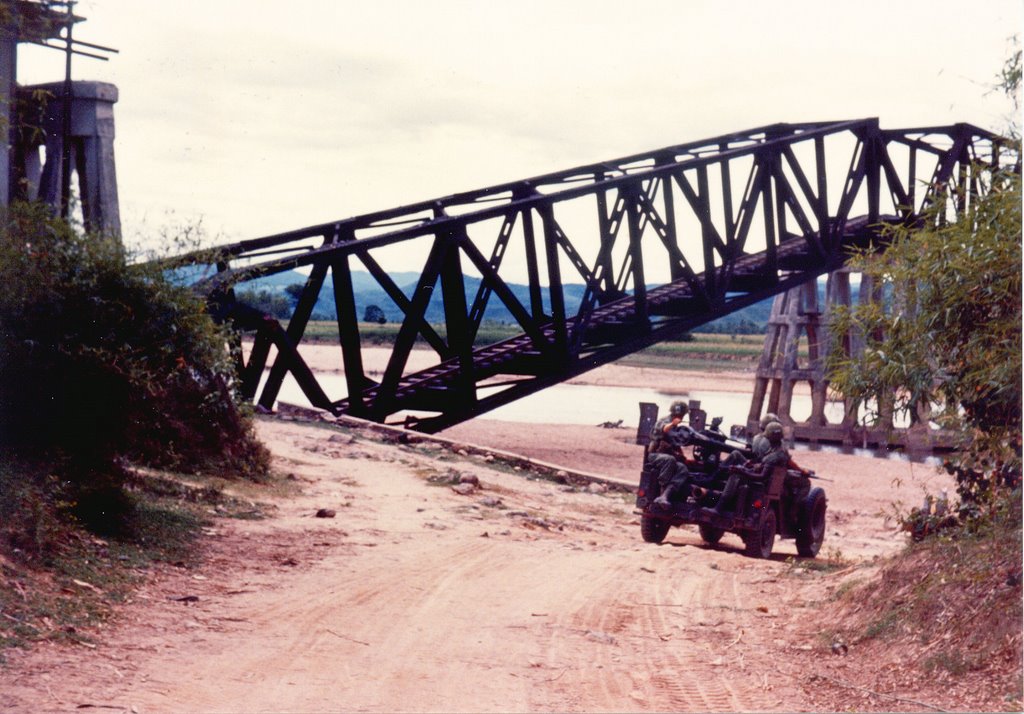
The below picture is a section of railroad bridge collapsed by a well placed explosive charge. Again, this was a result of enemy action against South Vietnam's government.

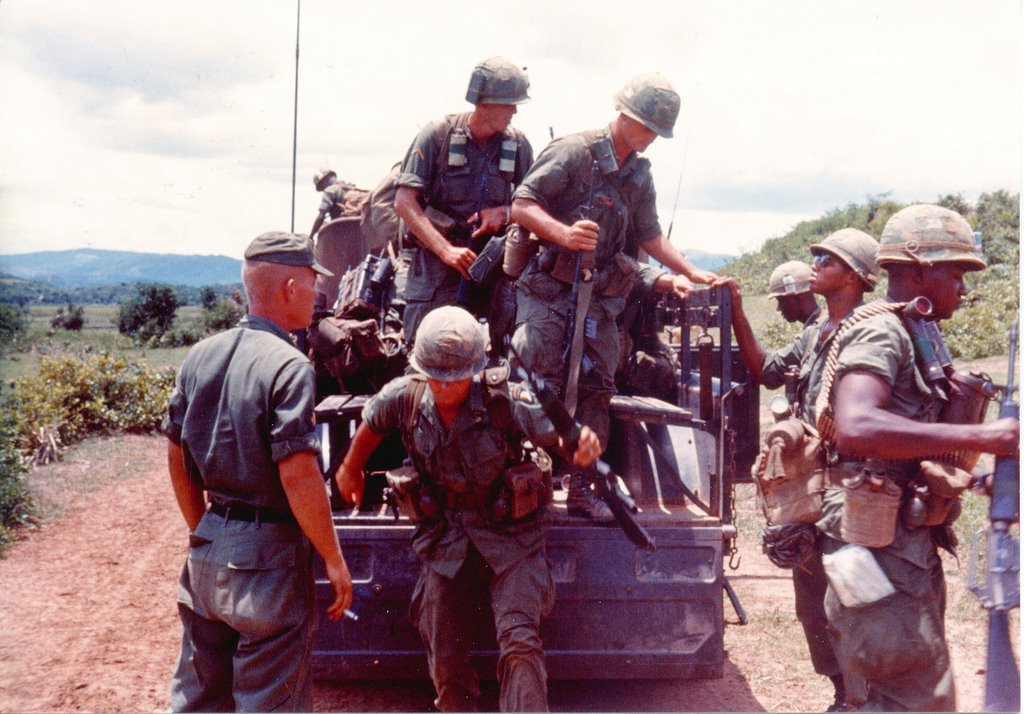
The bottom most picture is my squad at a drop point where we began a long-range patrol. This meant spending several days and nights in the countryside in search of the enemy. Sometimes we were delivered to drop points by truck and other times we were taken by helicopter. I loved helicopter rides when the pilots flew only a hundred feet above the ground at a speed of a hundred miles per hour. This approach made us less of a target as we made airborne entry into enemy territory.

Return here on Wednesday, September 13 for the start of a series on my good friend, Herschel Lamb.

Have a good day!


Labels:

Wednesday, August 30, 2006

Young Soldiers


The top picture is me (in shirt) standing beside PFC. Rodriquez, a friend in the same platoon as me. He arrived in Vietnam a few weeks before me and was assigned to carry an M-60 machine gun. He was from Mexico if I remember correctly. I served along side soldiers who were from Mexico, Puerto Rico, Guam, and the Philippines. During my basic training at Fort Gordon, I visited the fort's swimming pool one Sunday afternoon and heard most soldiers at the pool speaking Spanish. I believed they were bilingual and chose to speak in their native tongue when together socially because on duty they spoke English.

Some young people from foreign countries serve in the U. S. Military to help secure U. S. citizenship. An honorable discharge from the military goes a long way toward gaining the highly sought U. S. citizen status.

Rodriguez was very strong and carried heavy loads for long distances. The M-60 and ammo were heavy. Other squad members assisted in carrying machine gun ammo belts.
These belts crossed our shoulders and dangled under opposite arms. Every fifth round was a tracer which glowed when this high velocity, long-range shell was fired. This visible trajectory assisted the gunner to zero on the target. It was amazing to watch these tracer rounds, especially at night.

A squad is made up of 8 to 10 soldiers including the non-commissioned officer. When our squad walked trails or roads on patrol, Rodriguez was near the center of the line-up. There was a point person to lead the formation and a rear guard was the last person.

When we were ambushed or received enemy fire, we immediately hit the ground in the prone position and crawled to protective cover and then returned fire. When Rodriguez got in position, he laid down a barrage of machine gun fire to cover our squad as we advanced toward the enemy. Then we fired our M-16 assault rifle to cover his advance to keep in line with us. He also fired the machine gun from his hip when necessary.

The picture below shows two squad members. I was with these guys for almost a year, but I don't remember their names. The one holding the rifle was a sniper. He used a special rifle and had received advanced marksmanship training. We were in the rear area in Tuy Hoa when this picture was made.

We slept in the tents in the background when we returned from missions. While on missions, we camped on the ground with no cover and slept in two hour shifts. Two hours of sleep alternating with two hours awake for the duration of the night.

This secured area is where we rested, bathed, and prepared for the next mission.

The bottom picture is Rodriguez again. I wonder where he is today.

Return here on Friday, September 1 for an update.

Have a good day!


Labels:

Thursday, August 24, 2006

Southeast Asia


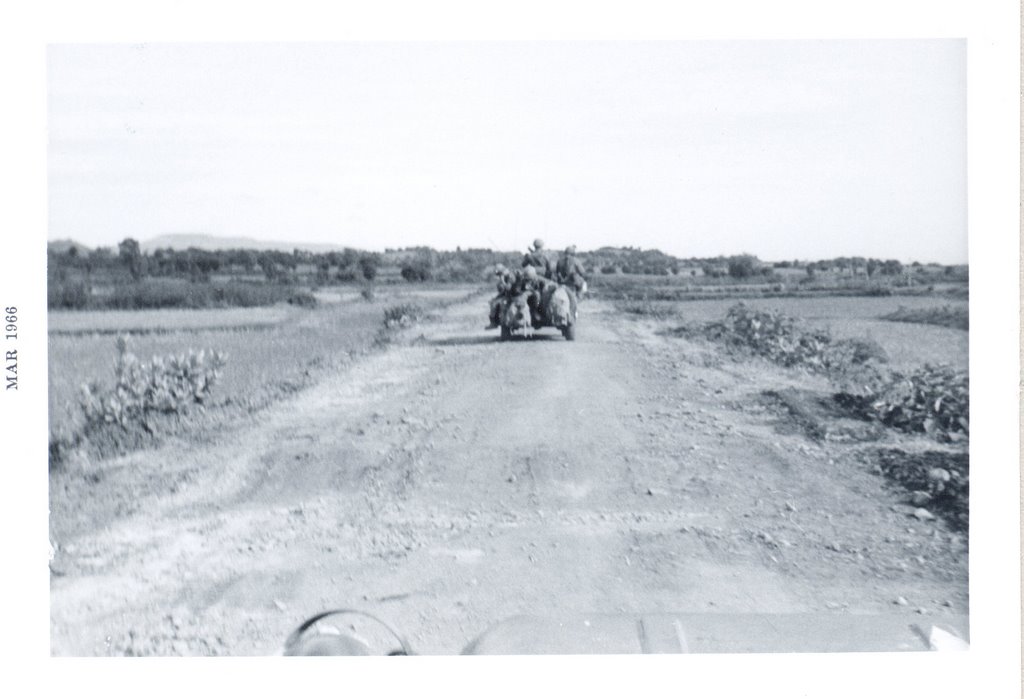
The top picture is the jeep in front of me as we moved along a dirt road between rice paddies. Rice was the big crop grown in the areas where we operated in Vietnam. After the rice crops were harvested, the paddies became dry and hard and we could walk across them without sinking. There were narrow raised areas around every few acres to contain the water and for walking by farmers and their cattle. Water buffalo were used in cultivating the rice paddies.

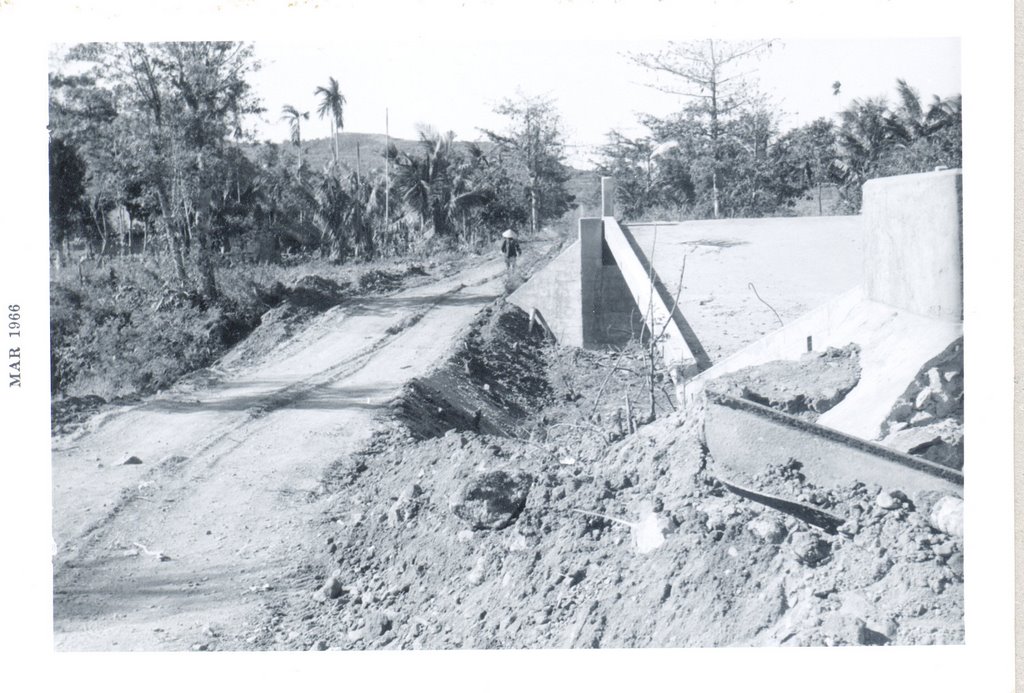
The picture below shows a blown bridge and the bypass around the destroyed overpass. I remember this stretch of road north of Tuy Hoa. The bridge was most likely destroyed with explosives set by Viet Cong guerrillas. Viet Cong or VC were usually South Vietnamese who fought without uniforms for the north. They were small bands of fighters who would blend with the civilian population. The VC employed ambush, hit and run, and sniper tactics when confronting U. S and ARVN forces. ARVN was Army Republic of Vietnam, the legitimate army of South Vietnam.

Viet Cong frequently buried mines in roads during the night. They were usually pressure sensitive type mines that exploded when a vehicle rolled over them. These mines caused many deaths and injuries to civilians as well as U. S. Military personnel. Sweeping the road with metal detectors was a daily task by military personnel.

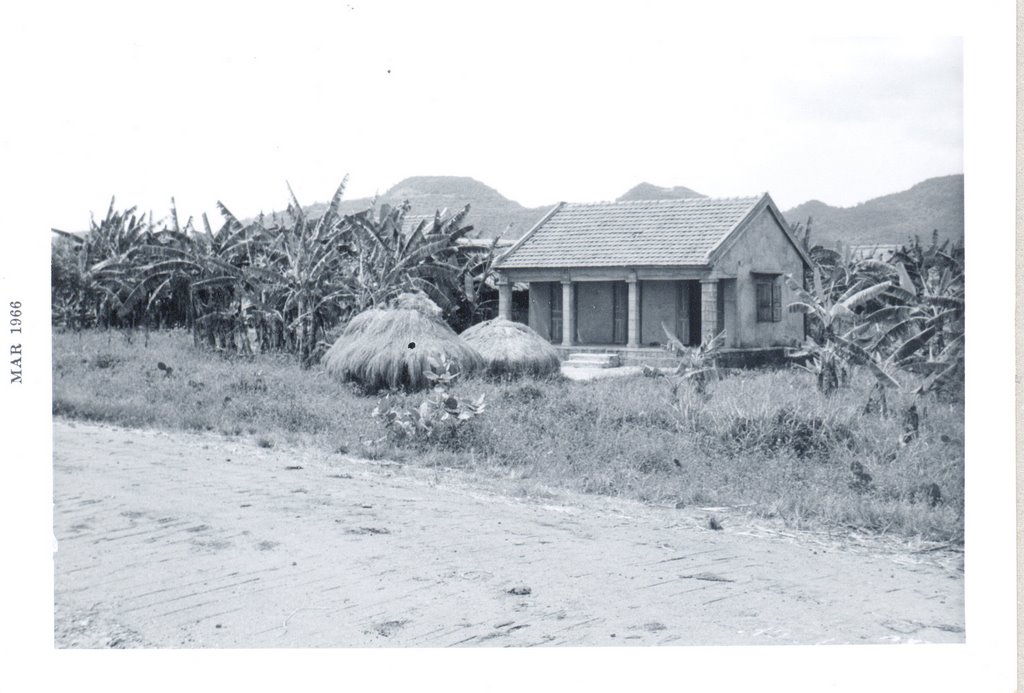
The last picture is a non-typical masonry or stone building beside a road.

How did the United States get involved in Vietnam? If you're my age (around 60), you've heard this question debated. If you're younger than 40 you may or may not know the answers.

As a nineteen year old person at the time of the mid-1960's, my understanding was that we (the U.S.) had been asked by the government of South Vietnam to help them secure their country from aggression by North Vietnam. North Vietnam was a communist government and the United States was concerned about the spread of communism in southeast Asia. This spreading was referred to as the domino effect of one country after another falling to communism. Cuba, closer to home, had recently come under dictatorial or communist control.

When I arrived in Vietnam, there were around 60,000 US troops there. When I departed a year later, I recall that there were twice that many. During the peak of that 12-year war, there were over 500, 000 in country at maximum build-up.

The United States involvement in the war began around 1963 and ended in 1975. I was there early as the war scaled up in 1965. My tour of duty lasted the full year of 1966.

I belonged to a combat unit in the 1st Brigade of the 101st Airborne Division. Some officers in this brigade became highly decorated for combat actions and, deservingly, gained national attention. David H. Hackworth (Captain or Major at the time) became the most well known with his book titled About Face. He made many television appearances to talk about military affairs during the years after the war.

Return here on Saturday, August 26 for an update.

Have a good day!


Labels:

Sunday, August 06, 2006

Another Memory


A few weeks ago I attended a funeral at a nearby church for an acquaintance in the neighborhood. He died at age eighty. In the eulogy given by one of his daughters she expressed regret and remorse for not talking with her dad about his experiences in WW II. Just before his death she said, "I joined him for a restaurant meal and asked him questions and was enlightened by what he said about his experiences." But, this dialogue was too late in his life.

I think the above situation is common. Young people are busy, have their own agendas, and little time for discussions with older people. This is one reason I'm recalling and documenting my experiences and feelings, and writing them on this blog.

Five, twenty-five, a hundred years from now, descendents or someone may stumble upon this blog and find my written words and pictures interesting history. If so, it will be worth my efforts of putting these bi-daily blog updates in print.

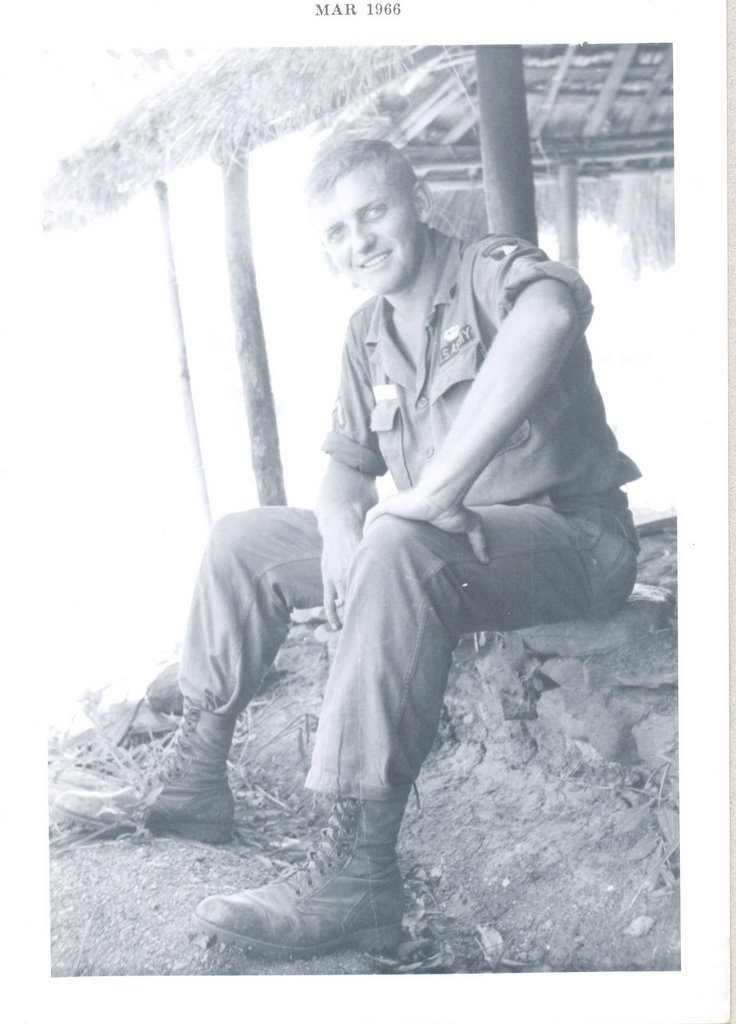
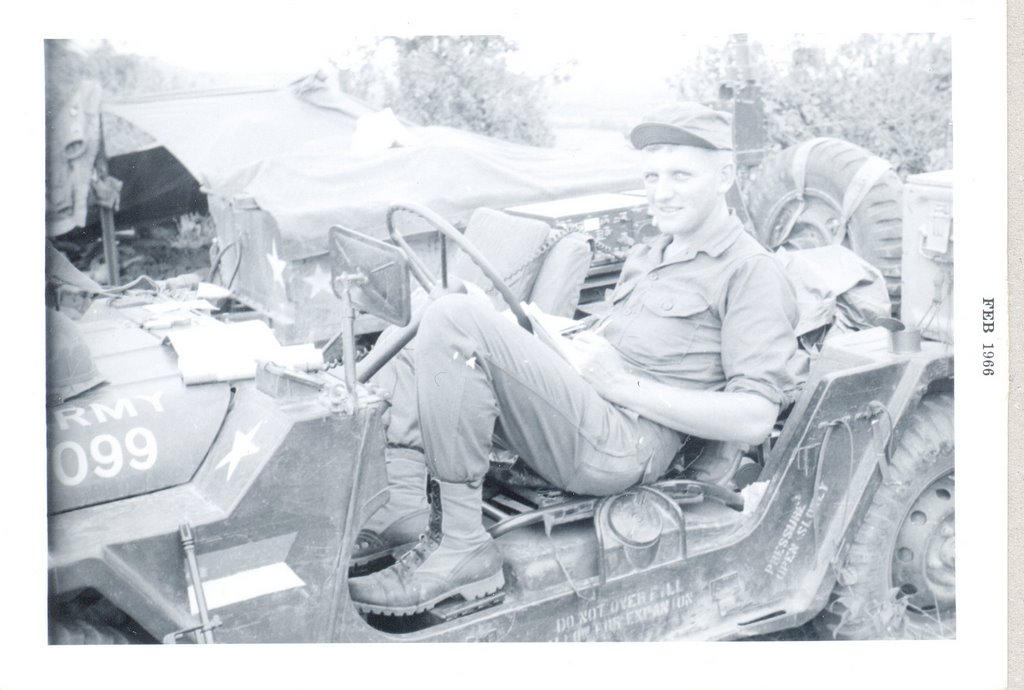
The top picture is of me somewhere in Vietnam in February 1966. 

Daily existence in Vietnam was difficult. The weather was always hot both day and night. The range of temperatures were mid 70's to high 90's. There was no ice to cool drinks or air conditioned spaces to get relief.

There were periods of monsoon which was continuous rain for several days and nights. We were soaking wet all that time.

There were no toilets, showers, beds or laundry services except in rear areas. Rear area was a heavily guarded space near a town and next to an airfield. The rear area we used most often was near a coastal town named Tuy Hoa. The airfield was only big enough for small aircraft and helicopters. The military used laundry services of the civilian population to clean our clothes. We returned to this rear area one or two days per week to change clothes, bathe, eat cooked meals, and sleep on a cot under a two-man tent that was surrounded by sandbags.

Here we would rest, clean our weapons, replenish our ammunitions, and get more c-ration meals for the next deployment to the countryside. These deployments meant squad or company size foot patrols into areas of suspected enemy habitation. The officers and non-commissioned officers received instructions, studied maps, and planned our next mission.

The picture below is a convoy of jeeps ready to move to another area or ride patrol on the coastal highway that ran north to south. The man in the passenger side of one vehicle is 2nd Lieutenant Palmer who was the officer over our platoon. Lieutenant Palmer's driver, standing by the jeep, was Spec. 4th Class Hovland.

Return here on Tuesday, August 8 for an update.

Have a good day!


Labels:

Sunday, July 23, 2006

A Memory

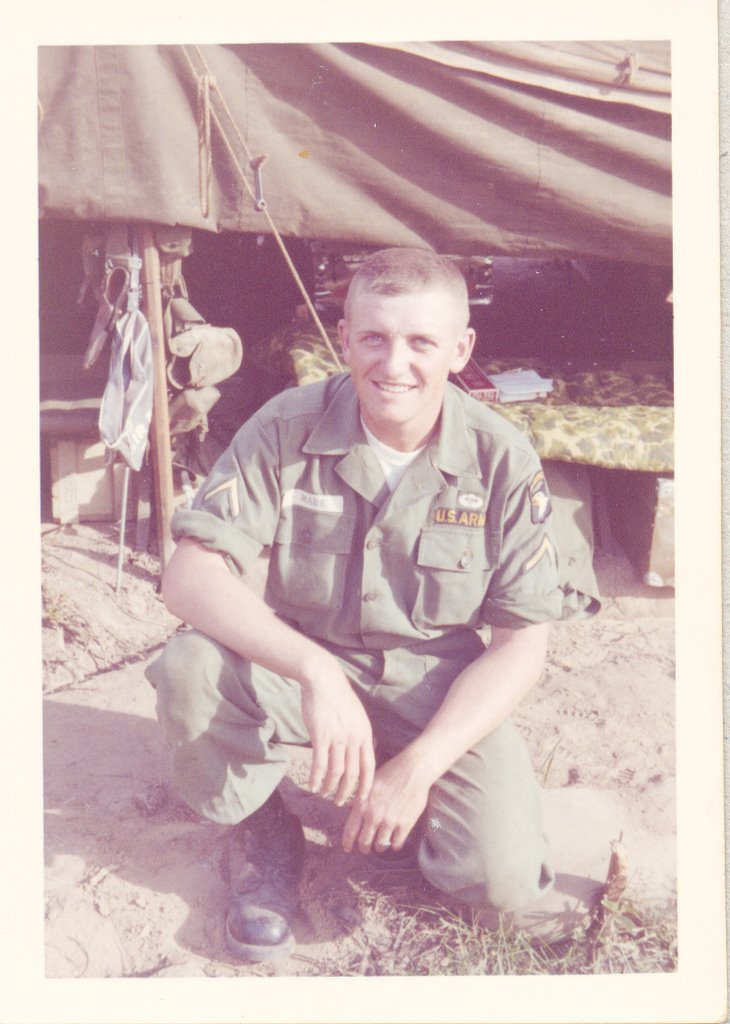
The picture of me below was taken the first week in January 1966. I was age 18, 5' 11" tall, and 165 pounds. I had recently arrived at the 101st Airborne Division's base camp in Phan Rang, South Vietnam. My journey to this place began in Pfafftown where I was on leave (vacation), to San Francisco two days before Christmas 1965.

I worked that Saturday, December 25, 1965 in the Army's Oakland Processing Center on "kitchen police" duty. "KP" was a 16-hour day of hard labor in a mess hall to feed fellow soldiers, clean the kitchen, and restore the dining room after each meal. KP was an exhausting and dreaded detail that soldiers of low rank were assigned to help the mess sergeant with food preparation.

Between Christmas and New Year's Day, 1965, I flew from San Franscisco to Hawaii to Saigon.
After a couple days of processing near Saigon, I was flown north a couple hundred miles to a base camp where I joined my assigned combat unit Troop A, 17th Cavalry of the 1st Brigade, 101st Airborne Division.

During the months leading up to this point, I completed Basic Training and Advanced Infantry Training at Fort Gordon near Augusta, Georgia and Paratrooper Training at Ft. Benning, also in Georgia.

After I arrived in San Francisco by commercial airliner from Atlanta, I called home and was told by my parents that the Department of Defense in Washington, DC had sent a telegram instructing me to stay there for the Christmas holidays and report later to Oakland for processing to Vietnam.

It was too late. I had already said my goodbyes and traveled across the country to Oakland, California as directed by my original orders.

I volunteered for military service and was proud to be a soldier. I completed training that many soldiers attempted, but dropped out due to stress, fear or physical exhaustion.

I remember the view from the airplane window on the tarmac of Smith Reynolds Airport in Winston-Salem, NC around 12/21/65. My family stood behind the short chain-link fence waving as the airplane pulled away. Only a few passengers were on the plane with me as my father, mother, sister, and brother were the lone people standing there waving that cold, winter day.

It was a sad day for them and me as the propeller driven plane pulled away from the parked position on the tarmac.

I was now in Vietnam, a world away from life, as I had known it.

I will report here periodically in the weeks ahead about how I felt, some of my experiences, some places our missions took us, some people I worked and fought along side, and the environment of guerrilla warfare from a low- rank infantryman's view.

Return here Tuesday, July 25 for an update.

Have a good day!

Labels: